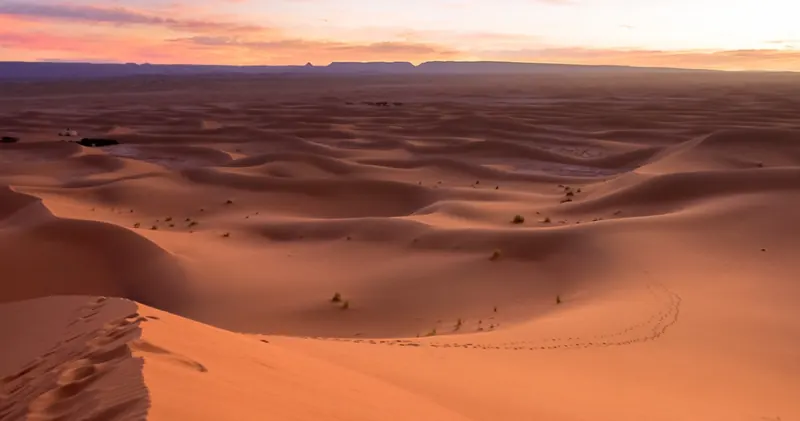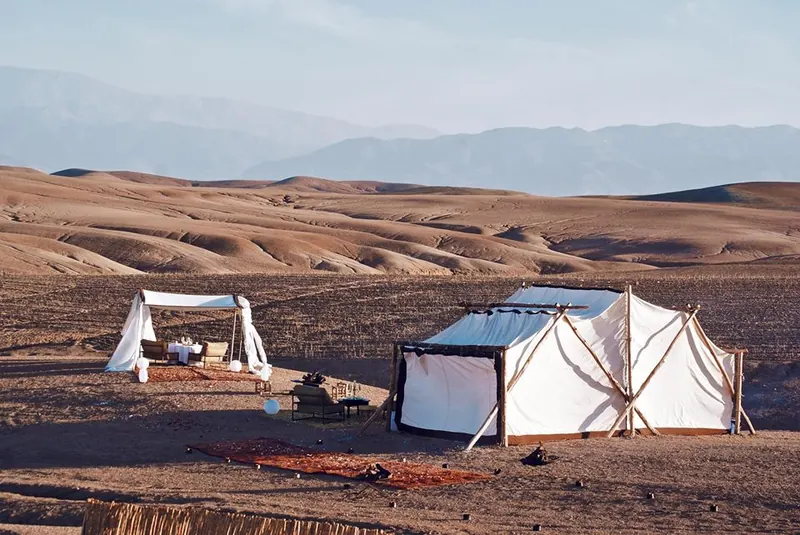
From Aït Bouguemez, the “Happy Valley”, to the M’Goun gorges and the Valley of Roses, this trek crosses the wildest and most remote valleys of the central High Atlas. It is a varied walk, with constant encounters with local people along the way. Here is what you need to know to prepare for it.
The essentials
- Season: April to the end of October;
- Length: 10 days, from Marrakech back to Marrakech;
- Distance: about 50 km on foot;
- Maximum elevation change: +1,200 m and -700 m;
- Highest point: the summit of M’Goun, at 4,068 m;
- Accommodation: nights with local families or in village gîtes, and nights under canvas at the camps; meals are prepared by our cook.
The route
You leave Marrakech at 8 am for Azilal, the gateway to the central High Atlas, then cross the Oughbar pass (2,200 m). The first two nights are spent with a local family in Timit (1,750 m), in the heart of the Aït Bouguemez valley: terraced fields and traditional irrigation, the villages of Tabant and Aït Imi, and dinosaur tracks at Ibaklioune.
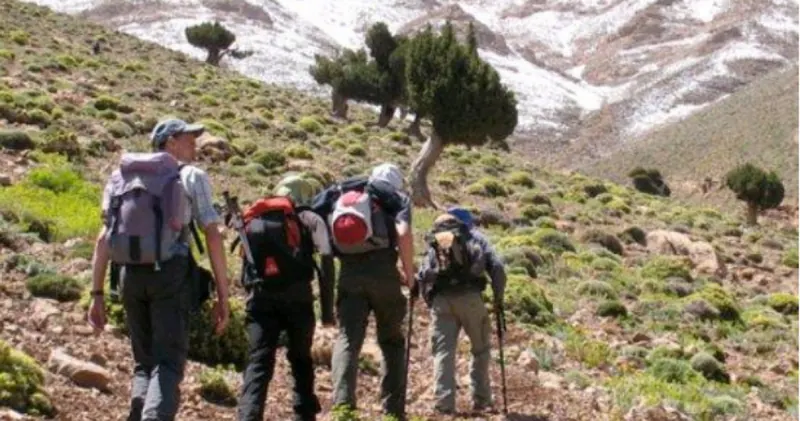
The trek then gains height: the collective granary and shrine of Sidi Moussa, a camp at Azib n’Ikkiss (2,300 m), then the Tarkeddit pass (3,400 m) and its plateau, frequented by nomads and their herds of goats, sheep and camels.
The ascent of M’Goun
On summit day, breakfast is served at around 4 am and you set off at around 5 am; the cook carries the picnic. The climb is fairly long, about four hours at a gentle pace, but requires no technical skills. From the summit (4,068 m), the view stretches over the peaks and valleys of the South, the Valley of Roses and the Dadès. You then follow a fine ridge before descending to camp at Oulilimt (2,600 m): around 8 hours’ walking that day.
Down the valley and through the gorges
The Oulilimt valley is a seasonal home for Aït Atta herders on the move. You then follow the stream that becomes the M’Goun river down to the Aflafal spring, and on along the valley, past Berber villages, fields of maize and wheat, apple and walnut trees, to Imi n’Irkt, “the gateway to the gorge” in Berber.
Then come the M’Goun gorges, the finest and most spectacular in the High Atlas. Where they narrow, you walk in the water, often cold and refreshing, for about three hours. The trek continues, sometimes in the water, sometimes through fields, to Boutaghrar (1,500 m), where you stay in a gîte with a local family. On the last day, the transfer returns to Marrakech via Kelâat M’Gouna and the Tizi n’Tichka pass (about 6 hours by road), ending at the airport.
What to bring and expect
- Trainers for the gorges: you will definitely cross water, which can be cold with a strong current;
- Early starts: on the gorge day, you set off early to avoid the storms that often break between 2 pm and 6 pm;
- Changing temperatures: the further south you go, the hotter it gets;
- Good fitness: most stages involve 5½ hours of walking, and up to 8 hours on summit day.
As on all our treks, we work with local muleteers, buy from farmers and stay with local families. Contact us for the detailed programme and to plan your departure.